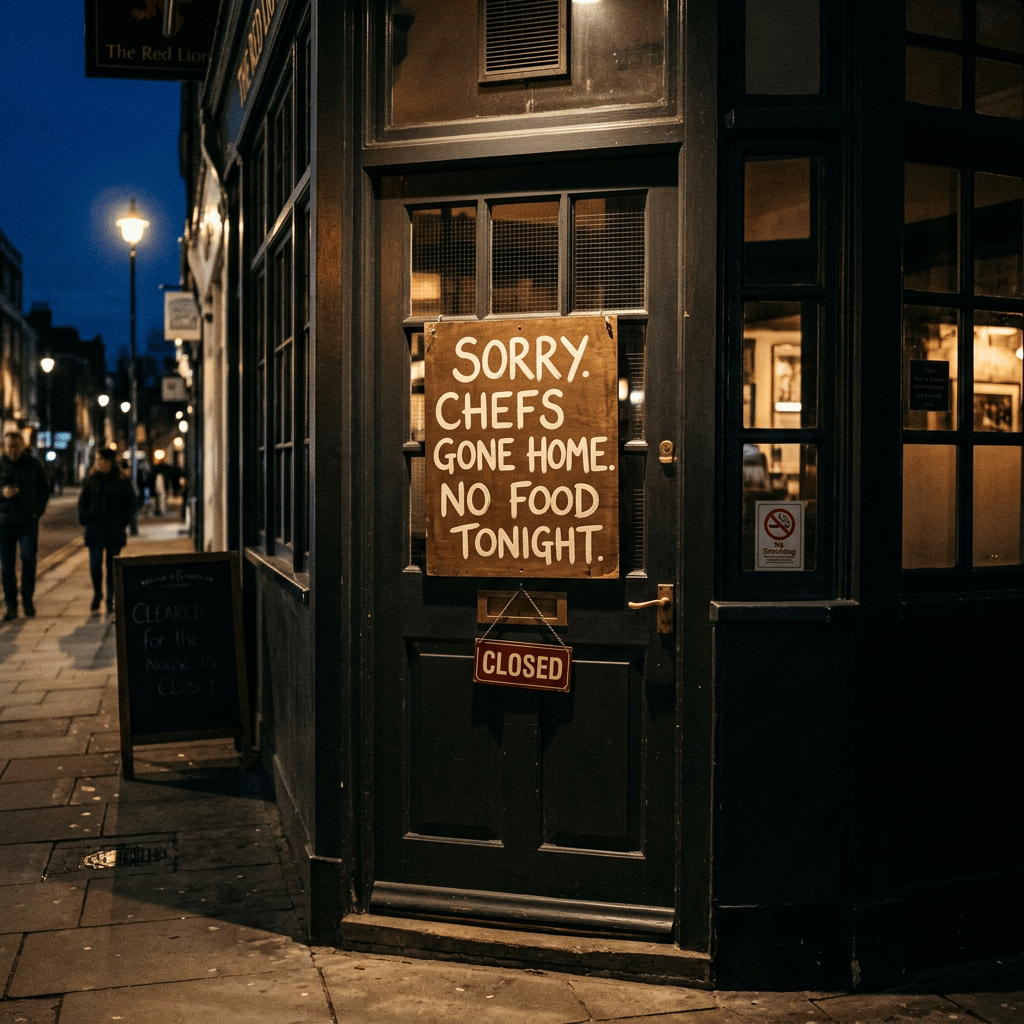
The Poem
I don’t know.
Maybe you’re still waiting
because you ordered
about five minutes ago.
Maybe you’re still waiting
because the server forgot
to take your ticket
to the kitchen.
Maybe you’re still waiting
because one of the chefs
forgot to order eggs.
And you ordered
the baked Alaska.
So now we need
Italian meringue
for service
without any eggs.
Maybe you’re still waiting
because we’ve been
so fucking busy tonight
the kitchen porter
is drowning in dishes.
The chefs don’t have
any pans to cook with.
We don’t have any plates
to put the food on.
Maybe you’re still waiting
because the food
actually takes time to cook.
Because we make it
fresh.
In-house.
Maybe you’re still waiting
because there are ten of you
and you’ve all ordered
something different.
Maybe you’re still waiting
because we’ve worked
six days this week.
We’ve been here
eight hours already.
Everyone’s tired.
And you know what?
Fuck it.
Let’s just stop.
Let’s stop tonight
and go home.
The chefs have gone.
You’re alone
in the restaurant.
Sorry.
The Plates
Some dishes are worth waiting for.
Fermentation. Slow cooking. Resting.
Time for flavour to build and develop.
For dough to ferment until it’s airy, light and pillowy, with a crisp crust.
For meat to cook slowly until the fat melts and everything becomes soft and rich.
For pickles to develop their tang.
For cabbage to soften but keep its crunch.
For onions and tomatoes to cook down until they’re sweet, sharp and sticky.
And then you put it all together.
Rich meat. Sharp pickles. Crunchy slaw. Sticky relish. Creamy aioli. Crisp crust. Soft, airy bread.
Fat. Acid. Salt. Sweetness. Crunch.
Everything took time.
Everything balances everything else.
Some things are worth waiting for.
Just make sure you order those fucking ingredients.
Plate One
Slow-Smoked Brisket Focaccia
48-Hour Sourdough Focaccia
Makes one tray
- 500 g strong white bread flour
- 400 g water
- 100 g active 100% hydration sourdough starter
- 12 g fine salt
- 20 g extra-virgin olive oil, plus more for the tray and finishing
Mix the flour, 370 g of the water and starter until no dry flour remains. Rest for 30 minutes.
Dissolve the salt in the remaining 30 g water and work it into the dough, followed by the olive oil.
Over the next 90 minutes, give the dough three or four sets of stretch-and-folds or coil folds. Leave until fermentation is clearly underway and the dough has become aerated and elastic.
Cover and refrigerate overnight, ideally 18–24 hours.
The following day, generously oil a tray. Ease the dough into it without forcing out the gas. Leave to proof until relaxed, bubbly and pillowy.
Dimple gently with oiled fingers, drizzle with olive oil and finish with flaky salt.
Bake at 230°C until deeply golden with a crisp base, approximately 20–25 minutes.
Cool before splitting for sandwiches.
Overnight-Brined Smoked Brisket
For approximately 6 generous sandwiches
- 1.5 kg beef brisket
- 30 g fine salt
- 15 g brown sugar
- 2 tsp coarse black pepper
- 2 tsp smoked paprika
- 1 tsp ground coriander
- 1 tsp garlic powder
- 1 tsp mustard powder
Combine the seasoning and rub thoroughly over the brisket.
Refrigerate uncovered overnight.
The following day, smoke at approximately 120–130°C until the bark is dark and developed and the meat is tender. Once the bark has set, wrap if necessary to prevent it drying.
Continue cooking until a probe passes through the thickest part with very little resistance — usually around 93–96°C internally, but tenderness matters more than the number.
Rest, still wrapped, for at least one hour before slicing across the grain.
Do not rush the rest.
You’ve waited this long.
Fermented Pickles
- 500 g small cucumbers, sliced or cut into spears
- 500 g water
- 15 g fine non-iodised salt
- 2 garlic cloves, crushed
- 1 tsp mustard seeds
- 1 tsp black peppercorns
- dill, optional
Dissolve the salt in the water.
Pack the cucumbers, garlic and spices into a clean jar and completely cover with brine. Keep everything submerged.
Ferment at cool room temperature for approximately 3–5 days, tasting as they develop.
Once properly sour and pleasantly fermented, refrigerate.
Cured Cabbage Slaw
- 300 g white cabbage, very finely sliced
- 6 g fine salt
- 15 g caster sugar
- 30 g apple cider vinegar
- 10 g Dijon mustard
- 15 g olive oil
- black pepper
Massage the cabbage with the salt and sugar and leave for 30–60 minutes.
Drain off excess liquid and gently squeeze the cabbage. Dress with vinegar, mustard, olive oil and black pepper.
Leave for at least another 30 minutes before serving.
It should be seasoned and slightly softened but still distinctly crunchy.
Charred Tomato & Onion Relish
- 300 g ripe tomatoes
- 250 g brown onions
- 2 garlic cloves
- 20 g brown sugar
- 40 g apple cider vinegar
- 1 tsp smoked paprika
- 1 tsp Dijon mustard
- salt
Char the tomatoes and onions hard enough to develop genuinely dark edges.
Finely chop and transfer to a saucepan with the garlic, sugar, vinegar, paprika and mustard.
Cook slowly until reduced, glossy and sticky but still recognisably a relish rather than a smooth jam.
Season and cool completely.
Garlic Aioli
- 1 egg yolk
- 1 tsp Dijon mustard
- 1 small garlic clove, finely grated
- 15 g lemon juice
- 150 g neutral oil
- 25 g extra-virgin olive oil
- fine salt
Whisk the yolk, mustard, garlic and lemon juice together.
Slowly emulsify in the neutral oil, followed by the olive oil.
Season with salt and adjust the acidity if necessary.
It should be sharp enough to cut through the brisket rather than adding another layer of richness.
To Assemble
Split the focaccia.
Spread generously with aioli.
Add warm sliced brisket, charred tomato and onion relish, cured cabbage slaw and fermented pickles.
Close and press only lightly — don’t crush the focaccia you’ve spent two days putting air into.
The finished sandwich should move between rich, smoky beef; sharp fermentation; fresh crunch; sweetness; acidity; creaminess; crisp crust and soft bread.
Nothing should win.
That’s the point.
Plate Two
Brown-Butter Mille Crêpes
Vanilla Cultured Cream & Caramelised Honey
Makes one 18–20 cm cake
Brown-Butter Crêpes
- 750 g whole milk
- 4 large eggs
- 50 g caster sugar
- 200 g plain flour
- 75 g unsalted butter
- 2 g fine salt
- 1 tsp vanilla paste
Brown the butter until deeply nutty and aromatic. Cool slightly.
Whisk the eggs and sugar together, followed by the flour and salt.
Gradually whisk in the milk until smooth, then add the vanilla and brown butter.
Strain.
Refrigerate for at least 2 hours, preferably overnight.
Cook very thin crêpes in an 18–20 cm pan. You’re aiming for approximately 20–25 usable layers.
Stack and cool completely.
Vanilla Cultured Cream
- 300 g thick crème fraîche
- 300 g thickened cream
- 60 g icing sugar
- 2 tsp vanilla paste
- pinch of fine salt
Whisk the crème fraîche, icing sugar, vanilla and salt until smooth.
Add the cream and whip until thick enough to hold the layers but still soft and silky.
Keep chilled.
Caramelised Honey
- 120 g good-quality honey
- 20 g unsalted butter
- generous pinch of flaky salt
Cook the honey gently until it darkens and develops a deeper, almost caramel-like bitterness.
Remove from the heat and whisk in the butter and salt.
Cool completely. It should remain fluid enough to drizzle.
To Build
Place one crêpe on a flat plate or cake board.
Spread with a very thin, even layer of vanilla cultured cream.
Add another crêpe.
Repeat.
And repeat.
And repeat.
Every few layers, add the faintest drizzle of caramelised honey — enough to punctuate the cake without making the layers slide.
Continue until there are no crêpes left.
Press very gently to level the cake.
Refrigerate for at least 6 hours, preferably overnight, before cutting.
Serve in clean wedges with a little caramelised honey.
Twenty-something crêpes.
Twenty-something layers of cream.
Brown the butter.
Rest the batter.
Cook every crêpe.
Cool them.
Layer them.
Chill the cake.
Then watch someone eat it in five minutes.
 Notes from the Pass
Leave a comment